
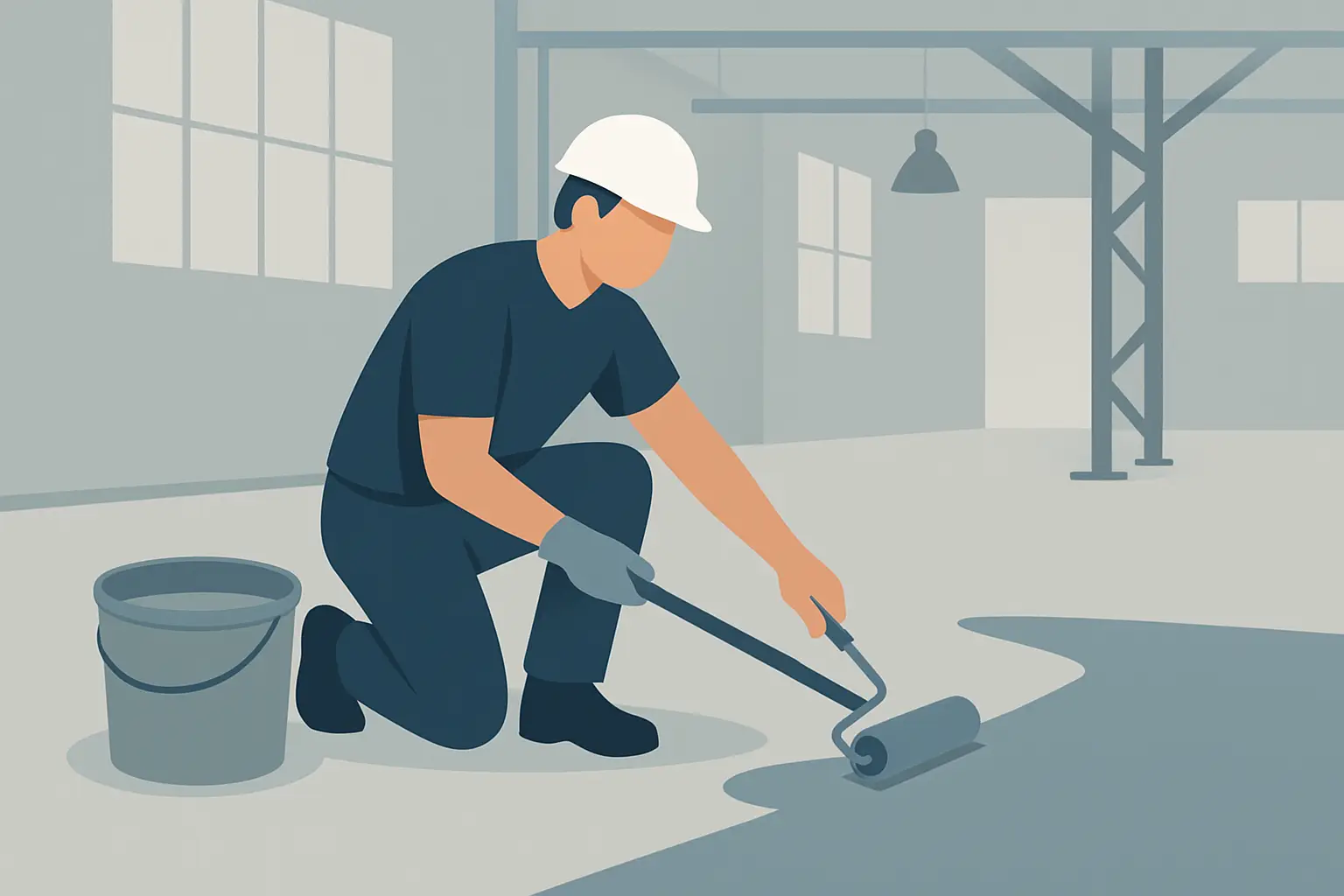
A failed epoxy floor rarely fails in a dramatic way. It starts with a hairline crack that becomes a delamination line. It starts with tire marks that won’t clean out. It starts with a glossy finish that turns slick during a washdown. In industrial facilities, those small failures become operational issues fast – safety exposure, shutdowns for repairs, and constant patchwork that never looks or performs like a designed system.
Industrial epoxy flooring installation is not a “coat the slab and go” trade. It is a controlled process built on substrate conditions, preparation quality, environmental discipline, and correct system selection for the way your facility actually runs.
What “industrial-grade” epoxy installation really means
Epoxy gets treated like a single product category, but performance comes from the system – primer, body coat, broadcast media (if used), topcoat, and detailing – installed to a spec that fits your traffic, chemicals, and cleaning methods.
For a light-duty space, a thin-build epoxy might be acceptable. For a production floor with forklifts, pallet jacks, point loads, and daily cleaning, thin-build becomes a maintenance plan, not a solution. Thickness, aggregate reinforcement, slip resistance, and topcoat chemistry are what separate “looks good on day one” from “still performing in year five.”
The trade-off is straightforward. Higher-build systems and more aggressive surface prep cost more upfront and typically require more downtime. But they reduce the chance of premature failure and repeated repairs – which is where lifecycle cost gets out of control.
Industrial epoxy flooring installation starts with the slab, not the epoxy
Every installation decision that matters comes back to concrete conditions. The slab is the structure. The epoxy is the wear surface. If the slab is contaminated, cracked, saturated, or weak at the surface, the epoxy becomes the sacrificial layer for issues that should have been addressed before coating.
Moisture is the most common failure driver
Moisture vapor transmission and elevated internal relative humidity can push coatings off the slab, especially in older buildings or slabs without an effective vapor barrier. You can’t eyeball moisture. It has to be tested.
If moisture levels are high, you may need a moisture mitigation primer designed for that condition, or you may need to rethink the system entirely. The practical reality is that moisture mitigation adds cost and demands strict installation control. Skipping it doesn’t save money – it shifts the cost into failure.
Surface contamination is more than “dirty concrete”
Industrial slabs often carry oil, coolant, plasticizer residue from old adhesives, and embedded chemistry from years of operations. Cleaning alone rarely solves it because contamination can live below the surface. This is why mechanical preparation is not optional. If you’re relying on acid etching or pressure washing to “prep” an industrial slab, you’re taking a risk with bond strength.
Surface preparation: where floors are won or lost
Industrial epoxy failures are usually blamed on the product. In reality, they’re usually traced to prep – profile, cleanliness, and sound concrete at the surface.
The goal of surface prep is to create a concrete surface profile (CSP) that matches the system build and to expose sound, uncontaminated concrete for mechanical bonding. Shot blasting is common for many epoxy systems. Grinding may be used for edges, repairs, or where shot blasting is impractical. The right method depends on slab hardness, existing coatings, and the required profile.
Prep is also where you find the truth about the slab. You see cracks you didn’t know existed. You discover spalls and soft areas. You locate old patches that won’t hold. That discovery phase is not an inconvenience – it’s risk control.
Crack and joint strategy matters
A coating system won’t stop concrete from moving. If you coat over moving cracks and expect the floor to stay monolithic, it will disappoint you.
You need a plan for joints and cracks based on use and tolerance for telegraphing. Some facilities accept visible crack lines in exchange for uptime. Others require a smoother aesthetic and tighter cleanability. Either way, joints need proper detailing, and repairs need to be compatible with the coating build and service conditions.
System selection: match the floor to the operation
A good installer can execute. A good spec prevents the wrong system from being installed in the first place.
In industrial environments, epoxy is often selected because it delivers strong chemical resistance, cleanability, and build options at a reasonable lifecycle cost. But epoxy is not always the best topcoat for UV exposure, and it is not always the best answer for rapid return-to-service schedules. Sometimes a hybrid system or urethane topcoat is the right call, depending on performance requirements.
Key selection variables should be operational, not cosmetic:
- Traffic type and frequency (forklift traffic, turning, hard wheels, steel casters)
- Chemical exposure (acids, caustics, oils, solvents, food byproducts)
- Thermal swings and washdowns (hot water, steam, temperature cycling)
- Slip resistance requirements (dry vs wet areas, footwear, slope-to-drain zones)
- Cleanability targets (food and beverage, pharma, high-hygiene environments)
If you operate in wet conditions, slip resistance needs to be engineered, not guessed. Aggregate size, broadcast rate, and topcoat selection must align with how the floor is cleaned. More texture can improve traction but may increase cleaning labor. Less texture can be easier to sanitize but may not be acceptable for safety in wet zones. It depends, and that “depends” should be resolved before the crew mobilizes.
Environmental control and curing discipline
Industrial floors don’t care what the calendar says. They care about surface temperature, ambient conditions, and cure time.
Epoxy chemistry is sensitive to temperature and humidity. Install too cold and cure slows or stops. Install too hot and working time collapses, which leads to roller marks, dry lap lines, and inconsistent film build. High humidity can create surface issues like amine blush that affect intercoat adhesion.
This is why the best installations are managed like controlled work, not like paint. Material staging, mix ratios, induction times (when required), batch tracking, and recoat windows are all part of execution quality.
Cure time is also a production decision. If leadership needs the floor back in service fast, the system must be designed for that timeline. Pushing a standard epoxy system into a forced early return is a common way to embed damage into a brand-new floor – gouges from pallet jacks, tire marking, and crushed texture before full cure.
Installation sequencing in active facilities
Most industrial sites can’t afford extended shutdowns. That reality shapes how industrial epoxy flooring installation should be planned.
Phased work zones, off-shift installation, and tight coordination with operations can protect uptime – but only if the contractor treats logistics as part of the job. Access control, material movement, ventilation planning, and protection of adjacent operations are not extras. They are the difference between a floor project that supports production and one that becomes a disruption.
If your facility has sensitive processes, you also need a plan for odor control, dust control during prep, and safe traffic routing. Those controls should be defined before mobilization, not improvised onsite.
Quality checkpoints that reduce risk
If you’re responsible for facility performance, you don’t need to micromanage the crew. You do need a few non-negotiable checkpoints that signal whether the installation is being managed to an industrial standard.
Moisture testing and documentation should happen before coating selection is finalized. Surface prep should be verified for profile and cleanliness before primer. Mix discipline should be visible – measured ratios, consistent batches, and no “free-pouring” hardener. Wet film build and coverage should be checked during installation, not after cure when it’s too late.
A contractor who welcomes those checkpoints is typically building the floor to last. A contractor who resists them is usually protecting speed over outcomes.
What drives total cost of ownership
The cheapest epoxy floor is the one that gets installed twice.
Lifecycle value comes from a floor system that fits your real abuse conditions and is installed with prep and curing discipline. When a system is underbuilt, you pay in cleaning labor, repairs, safety incidents, and downtime. When a system is overbuilt, you pay in unnecessary thickness and longer shutdown windows.
The right answer is a controlled balance – engineered performance where you need it, practical build where you don’t.
If you’re evaluating partners for this work, look for a contractor that treats specification support, prep, and execution control as the core product, not as optional upgrades. This is where a quality-first industrial flooring contractor such as Osis Group earns its keep – by delivering a system that performs under real facility conditions and by managing the project around operational uptime.
A floor is not a cosmetic upgrade in an industrial building. It’s a working surface that either protects your operation or becomes a recurring problem. The best time to get it right is before the first grinder hits the slab.
Leave a Reply